


Top 10 RB A vs. B analysis

Updated: Aug 20, 2021
As a connoisseur of fantasy football, and someone who plays in a very competitive league, I am always looking for an edge over my leaguemates. I've found that in my most competitive leagues, gaining that margin for victory becomes ever fleeting with each passing year, as my competitors get better at analyzing, and fantasy football continues to grow. As a result, I started in previous years by simply comparing Strength of Schedules, which I feel is one of the most overlooked assets when deciding who to draft, and who to play on a week-to-week basis. In previous years, this was enough to get me into the playoffs, and eventually to win five consecutive titles in my stingy keeper league. I'd use this simple tool of S.O.S. to base drafts on, find overvalued players to trade away, and select who to start/sit when in a bind. This worked well for a while, however, the past 3 years it hasn't been enough as I've found myself falling just short of fantasy glory, and so I've decided to dig deeper into the S.O.S. and how it truly affects different positions. Thus, I give to you the Top 10 RB A vs. B Analysis
I was curious how much of an impact S.O.S. actually had on the final stats of a Running Back. Was I placing too much weight on it, or perhaps not enough? It was very difficult to tell when I should be sitting certain players based on this as I had no concrete number as to how it actually affected my player's final score. My theory was that RB's would of course score more points vs. worse competition as it would be easier to run against them, but more importantly game script would likely favor handing the ball off, rather than throwing. I began my little experiment first by compiling a list over the past 6 years of all teams who finished below .500 and labeling them as a "B", and then labeling all teams above .500 as an "A", hence the name "A vs B analysis".
I then looked at every top 10 RB from those years and marked each matchup they played as an "A" or a "B."
If they played 50% or more of their games vs. "B"-ranked competition they fell into the B category themselves,

meaning they had an easier schedule. As it turned out, 67% of all top-10 RB's over that period fell into this category. This essentially means if that trend is to be believed, your stud RB is 2/3 more likely to finish in the top 10 if he plays garbage teams. Now of course this is to be taken with a grain of salt, There are injuries to avoid, and of course that Running Back has to be talented and get touches. Once all of that is figured out, this could become another indicator to take into account when analyzing the position. This certainly began to prove my theory about the correlation of "B" schedules contributing to success, but perhaps these RB's just had easy schedules but were trashing the minority of their "A" matchups. I needed to know for sure and I dove in further.
As I continued to traverse this obscure data, I needed a way to confirm that B vs. A. actually meant something. The next step I took was to break it down on a matchup-to-matchup basis to see if more points
were actually scored against bad teams. I knew that 67% of these top 10 RB's had B schedules but did they truly score more points against those bad teams or was it merely a coincidence. Therefore, I then broke down every matchup for every top 10 RB over the past 6 years and took their scores per week minus their average PPG for that season. I added up the totals from all "A" games and all "B" games separately to see if their was a correlation or not. Once again, my suspicions were confirmed, as 67% of RB's scored more points in these individual match-ups vs. B teams than they did vs. A teams. More-so, even many of the RB's with "A" schedules scored more points against "B" teams, taking advantage of the fewer opportunities they got to play weak opponents. It's unclear what contributes to this point differential. It may be due to simply playing bad competition, or what I theorize has more to do game script. I would imagine playing a bad team lends itself to allowing the RB more touches and being less likely to have to play from behind. nevertheless I knew I was on to something now, however, I still didn't have an actual point total to put towards this theory of mine and so, just as Neo would, I took the red pill and went further down the rabbit hole that was "B vs. A" RB's.
Once my confirmation bias wore off, and I hung up from my call to my co-host to brag a bit, I decided to
delve into just how much these matchups truly could swing things on a player-by-player, week-to-week and

even on a season-long basis. I found that these top 10 RB's scored 1.5 more points per week against "B" teams than they did vs. "A" teams. This at first seemed so trivial to me, as I'm sure it probably does to you. "An entire article to find me 1.5 points, thanks a lot Reber!" Well imagine this, You have two starting RB's for that week, and a flex RB. If all three go against "B" teams that's on average an additional 4.5 points. Still trivial? Perhaps, however imagine your opponent starts their three RB's vs. "A" teams. Now were looking at a 9 points-per-week swing. Obviously, this isn't always going to be the case, but it's nice to know the ceiling for a particular trend. On a season-long basis if this trend were followed by only you it's an additional 72 points for you fantasy team. Double that number if your opponent neglects to employ this piece of information, themselves. To take this a step farther 144 points in my league last year was the difference between 1st and 5th place as far as points-for go. In addition, 19 games were decided by 9 points or less in my league last year, which would have drastically altered seeding, playoff berths and perhaps who won it entirely.
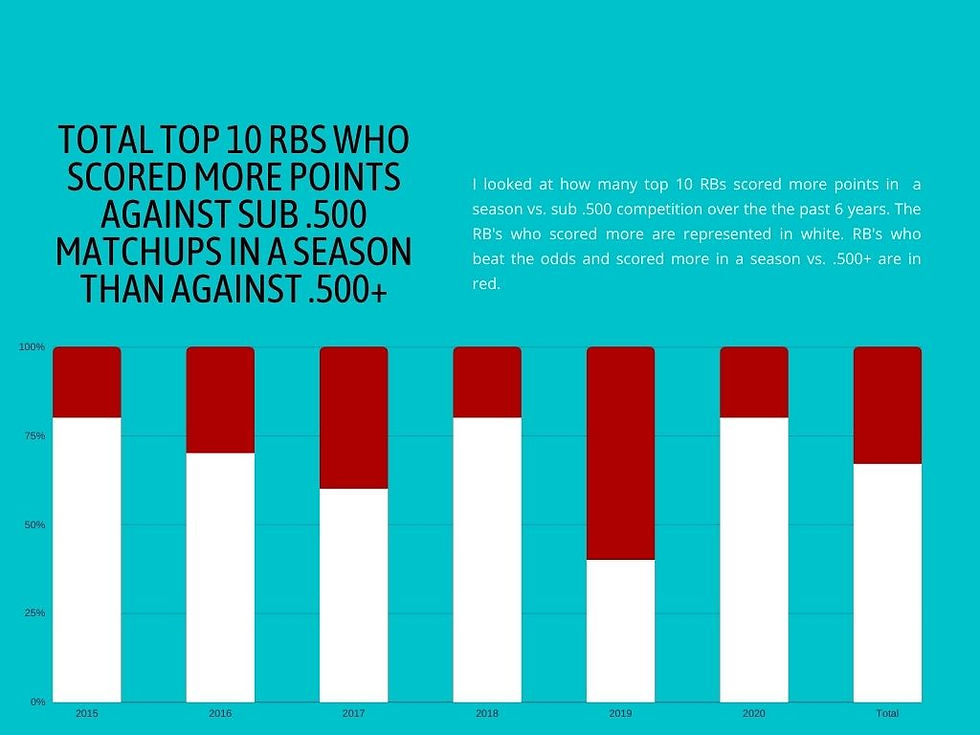
The last thing I'd like to do is leave you with this chart & list of RB's who bucked this trend of scoring more vs. "B" teams and actually outperformed on the "A" teams. I'm honestly not sure what to make of this info, but

perhaps it will be helpful to you, so I'll do my best to break down this list as truncated as possible. A few trends I did notice from this chart. Elliott is the only RB to buck this trend three times, in three consecutive seasons, which tells me they rely heavily on him in big games. three other RB's bucked this trend twice, David Johnson, Run CMC, and Kamara, however D. Johnson has still scored more points overall vs. "B" teams in his other top ten appearances throughout the years I researched. Kamara and McCaffery join Zeke on the list of repeaters who have actually scored more over their careers against "A" teams and done so multiple times. One more note, the Blount, and L. miller appearances were both career high in TD's for them, and 18, and 10 respectively. I did try looking for patterns here, maybe it was pass catching RB's or teams without a top tier QB but I hadn't found any thus far.
To sum up the RB "B vs. A" findings, obviously, predicting what team will be an "A" or "B" matchup before a season isn't an exact science, and I'm in no way saying you should go grab David Montgomery over Run CMC in the first round cause some idiot with a podcast told you to do so based on his S.O.S. What I am saying is I do feel this could be a valuable tool in breaking ties between two players in a similar tier when drafting and creating you rankings. It can also be used as a factor when deciding who to start/sit if your in a close debate between two similar players in crunch time. I'm certainly looking forward to less indecisive lineup tinkering at noon on a Sunday now that I have this tool I can utilize in a pinch. I do plan on doing this same analysis for QB's and WR's which I hypothesize will have an inverse relation, again due to game script. so please keep an eye out for those articles and I hope all of your fantasy teams are "A's" this year.
Comments